
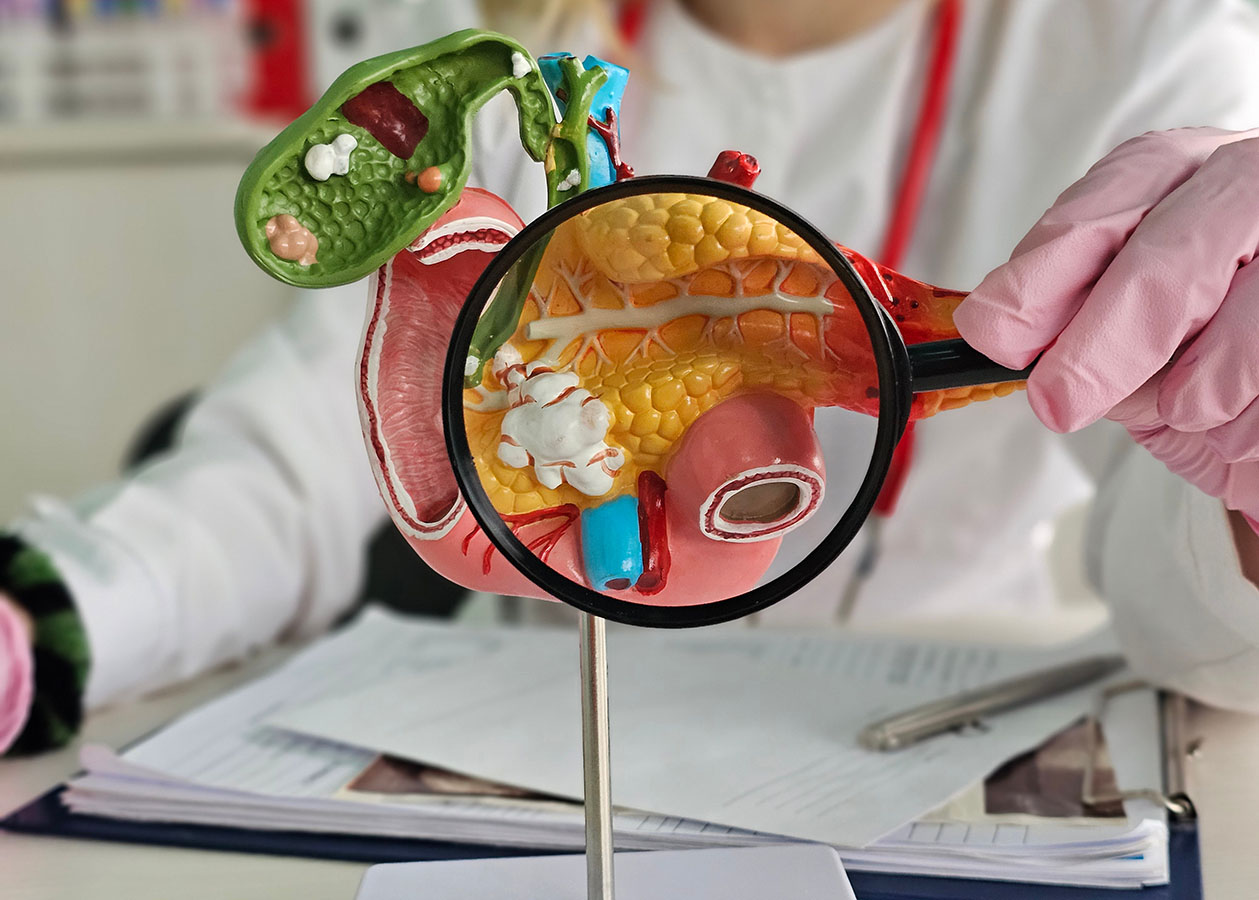
The pancreas is an organ located behind the stomach. It produces enzymes that help digest food and hormones, including insulin, that help regulate blood sugar.
Pancreatic disorders can affect how the pancreas functions or cause inflammation and changes within the pancreas or its ducts. These include acute and chronic pancreatitis, pancreatic cysts and other conditions affecting the pancreatic ducts or digestive function.
Symptoms vary depending on the condition. Some pancreatic disorders cause sudden, severe abdominal pain, while others develop gradually or are discovered unexpectedly during an ultrasound, CT or MRI scan performed for another reason.
Finding the underlying cause is important because the treatment and follow-up required can vary considerably between pancreatic conditions.
Concerned about pancreatic symptoms or an abnormal scan result?


Acute pancreatitis is sudden inflammation of the pancreas.
It can cause severe upper abdominal pain, often accompanied by nausea and vomiting. The pain may spread through to the back.
Gallstones and alcohol are among the common causes, although pancreatitis can also occur because of:
Sometimes, no clear cause is identified.
Acute pancreatitis can range from relatively mild illness to a serious condition requiring hospital treatment.

Chronic pancreatitis is long-term inflammation that causes progressive and permanent changes to the pancreas.
Over time, this can affect the pancreas’s ability to produce digestive enzymes and, in some people, insulin.
Symptoms may include:
As pancreatic function declines, some people can develop problems absorbing nutrients or diabetes.

Pancreatic cysts are fluid-filled growths or collections within the pancreas.
Many are discovered incidentally during a CT or MRI scan performed for another reason and cause no symptoms.
There are several different types of pancreatic cysts. Most are not cancerous, but some types have the potential to develop concerning changes over time.
The appropriate approach depends on features such as:

The pancreas produces enzymes that are needed to properly digest fats, proteins and carbohydrates.
When the pancreas does not produce enough of these enzymes, this is known as exocrine pancreatic insufficiency.
It can occur in people with chronic pancreatitis and certain other pancreatic conditions.
Possible symptoms include:
Treatment may include pancreatic enzyme replacement and nutritional support.
Speak to a doctor if you experience:
These symptoms can have many possible causes and do not necessarily mean that you have pancreatic disease.
Symptoms depend on the underlying condition.
Some people with chronic pancreatic disease may develop fatty or oily stools, particularly when the pancreas is no longer producing enough digestive enzymes.
Different pancreatic disorders have different causes.
Factors that can contribute to pancreatic disease include:
Sometimes, a pancreatic disorder develops without an identifiable cause.
Blood tests can look for:
The appropriate tests depend on the condition being investigated.
A CT scan can provide detailed images of the pancreas and surrounding structures and is often used when pancreatic disease is suspected.
An MRI, sometimes combined with MRCP, can provide detailed images of the pancreas, pancreatic ducts and bile ducts.
Endoscopic Ultrasound (EUS) combines endoscopy with high-resolution ultrasound.
Because the pancreas lies close to the stomach and small intestine, EUS can provide detailed images of the pancreas from inside the digestive tract.
It may be used to:
Not every pancreatic condition requires EUS.
Endoscopic Retrograde Cholangiopancreatography (ERCP) allows access to the bile and pancreatic ducts.
Today, ERCP is used mainly for treatment rather than routine diagnosis.
In selected patients, it may be used to relieve an obstruction, remove certain duct stones or place a stent to improve drainage.
Because ERCP is an invasive procedure with potential complications, it is recommended when there is a clear clinical reason for performing it.
Your doctor will consider your symptoms, medical history, alcohol intake, medications, previous gallstone problems and any existing scan results.
Depending on the suspected condition, investigations may include:
Treatment depends on the condition and its underlying cause.

Acute pancreatitis usually requires medical assessment and may require hospital treatment.
Management can include:
For example, if pancreatitis is caused by a gallstone obstructing the bile duct, an ERCP may sometimes be needed.

Some people with specific pancreatic duct problems may require endoscopic or other treatment.

Not every pancreatic cyst needs treatment.
Many cysts can simply be monitored with periodic scans.
Further investigation may be recommended if the cyst has particular features, is causing symptoms or changes over time.
EUS may sometimes be used to examine a cyst more closely or obtain a sample of cyst fluid.
Treatment decisions are based on the individual characteristics of the cyst rather than simply its presence.

If the pancreas is not producing enough digestive enzymes, pancreatic enzyme replacement therapy may be prescribed.
These enzymes are taken with meals to help the body digest and absorb nutrients more effectively.
Dietary and nutritional assessment may also be helpful, particularly if there has been significant weight loss.

If you have persistent upper digestive symptoms or have been advised to undergo a gastroscopy, a gastroenterologist can assess your symptoms and advise whether the procedure is appropriate for you.
Dr Amitabh Monga
Senior Consultant Gastroenterologist
Pain from the pancreas is often felt in the upper abdomen and may spread through towards the back. It can be sudden and severe in acute pancreatitis or recurring and persistent in some chronic pancreatic conditions.
However, many digestive conditions can cause similar pain, so the location of pain alone cannot confirm that it is coming from the pancreas.
No. Most pancreatic cysts are not cancer.
There are several types of pancreatic cysts, and their potential to develop concerning changes varies. Your doctor will consider the cyst's size, appearance and other features to determine whether it simply needs monitoring or requires further assessment.
Acute pancreatitis develops suddenly and usually improves after the inflammation settles and the underlying cause is treated.
Chronic pancreatitis involves long-term damage to the pancreas and can gradually affect its ability to produce digestive enzymes and insulin.
Repeated episodes of acute pancreatitis can sometimes contribute to chronic pancreatic damage.
EUS provides detailed images of the pancreas because the ultrasound probe can be positioned very close to it from within the stomach or small intestine.
It may be recommended to investigate a pancreatic cyst, clarify an abnormality found on another scan or obtain a tissue or fluid sample when necessary.
Not everyone with a pancreatic condition requires EUS.
Pancreatic disorders can present in different ways, from sudden abdominal pain to an unexpected finding on a scan. An assessment can help determine the cause and whether further investigation, monitoring or treatment is needed.